A classic Pavlova pairs a delicate crisp shell with a soft, marshmallow-like center.
Cold whipped cream and fresh fruit balance the sweet meringue with creamy texture, bright color, and gentle acidity.
The dessert looks elaborate, but its success depends more on clean tools, gradual mixing, low heat, and patient cooling than on specialized equipment.
With four egg whites, sugar, and a few stabilizing ingredients, you can prepare an elegant centerpiece using ordinary kitchen tools.
The method below preserves the original stages, from whipping and shaping the meringue to adding the fruit shortly ahead of serving.
What Is a Pavlova & Why This Recipe Works It
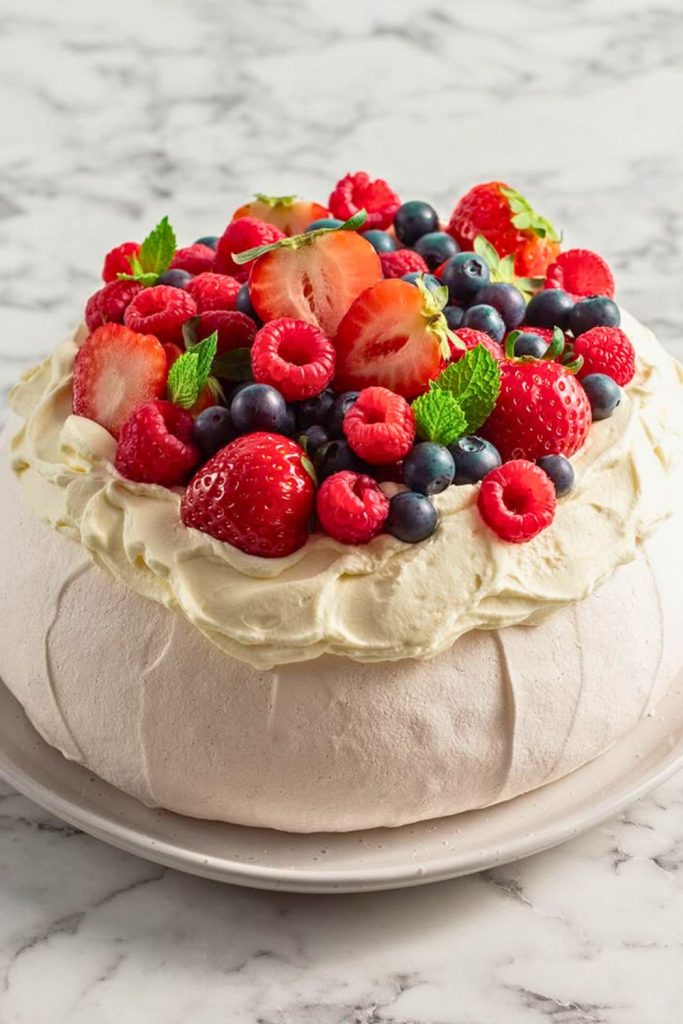
Pavlova is best known for its striking contrast of textures: fragile and crisp outside, tender and marshmallowy within.
The dessert was named for ballerina Anna Pavlova and became associated with Australia and New Zealand in the early twentieth century.
Its precise national origin remains a friendly point of debate, but it is a beloved celebration dessert in both countries.
At the center of the recipe is a baked meringue shell made from whipped egg whites and slowly dissolved sugar.
After the shell cools, it is packed with soft whipped cream and about three cups of fresh fruit, such as berries, kiwi, or passion fruit.
These are the qualities that make Pavlova especially appealing:
- Visually impressive: The tall white meringue and colorful fruit make a natural centerpiece.
- Light but satisfying: Airy meringue and fruit keep the dessert from feeling too dense.
- Easy to customize: Change the fruit, cream, curd, or garnish to fit the season.
- Short ingredient list: The base relies mainly on egg whites and sugar.
- Contrasting texture: Each slice includes crisp shell, tender center, and creamy topping.
Once you taste all three layers together, it is simple to understand why Pavlova remains a special-occasion favorite.
Ingredients of Pavlova
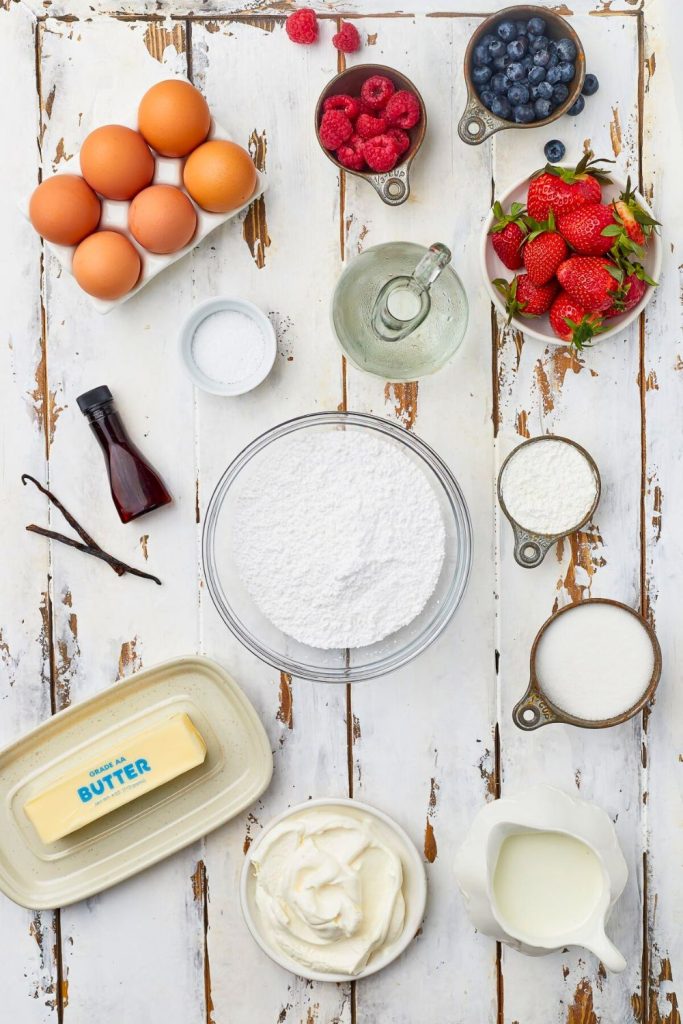
| Category | Ingredient | Amount / Notes |
|---|---|---|
| Meringue | Egg whites | 4 large, room temperature |
| Superfine sugar | 1 cup | |
| Cream of tartar | ½ teaspoon | |
| Fine salt | Pinch | |
| Vanilla extract | 1 teaspoon | |
| Cornstarch | 1½ teaspoons, sifted | |
| Whipped Cream | Cold heavy cream | 1½ to 2 cups |
| Powdered sugar | ¼ cup, or to taste | |
| Vanilla extract | 1 tablespoon | |
| Topping | Fresh fruit | About 3 cups |
| Optional garnishes | Mint, powdered sugar, passion fruit, or berry sauce |
How to Prepare Pavlova: Step-by-Step Method

Pavlova rewards an organized approach. Prepare the pan and ingredients first, then give the meringue enough time to whip, bake, and cool without interruption.
The finished dessert should have a dry outer shell, a tender center, and a fresh topping of whipped cream and fruit.
Use these 11 steps to keep the process clear and manageable.
Step 1: Get Your Oven Ready
Preheat the oven to 300°F (150°C). A fully heated oven gives the meringue a stable environment from the moment it goes in.
Line a baking sheet with parchment. Trace an 8- to 9-inch circle using a plate, bowl, or cake pan as a guide.
Turn the parchment over so you can still see the circle but the pencil does not touch the meringue.
Pro Tip: Avoid large temperature changes; steady heat helps develop a crisp shell without rapidly coloring the sugar.
Step 2: Separate the Eggs
The meringue uses the whites from 4 large eggs. Separate them with care because even a small amount of yolk can interfere with whipping.
A reliable way to separate them is:
- Crack one egg at a time into a small bowl.
- Move only the clean white into the mixing bowl.
- Transfer each yolk to another container and save it for custard, curd, or another recipe.
Tip: Separate eggs while cold, then let the whites sit at room temperature for about 30 minutes so they whip to better volume.
The bowl and whisk must be fully clean and grease-free. If needed, wipe them with a little vinegar or lemon juice and dry them before adding the whites.
Step 3: Begin the Meringue
Pour the prepared egg whites into the bowl of a stand mixer or a clean mixing bowl for a hand mixer.
Add:
- A pinch of salt for flavor
- ½ teaspoon cream of tartar to help stabilize the foam
Beat on medium-low speed for 1 to 2 minutes, until the whites look foamy with many small bubbles.
This even foam forms the foundation for a meringue that rises with a light texture.
Step 4: Stir in the Sugar Slowly
Measure 1 cup superfine sugar, but plan to add it gradually rather than pouring it in at once.
With the mixer on medium, stir in the sugar about 1 tablespoon at a time. Allow each addition to blend before adding more; this usually takes 5 to 8 minutes.
Superfine sugar dissolves more readily than standard granulated sugar. To make your own, process granulated sugar briefly until the crystals become finer.
Check the texture: Rub a small dab between two fingers. Continue mixing if it feels gritty; proceed when it feels smooth.
Step 5: Beat to Stiff Peaks
Increase the mixer to medium-high speed and whip until the meringue forms stiff, glossy peaks that remain upright when the whisk is lifted.
The mixture should become noticeably thicker, shinier, and much greater in volume.
Near the end, add 1 teaspoon vanilla extract and mix only until incorporated.
Peak Test: Lift the whisk and look for a firm tip that holds its shape. This is safer and more useful than turning the whole bowl upside down.
Step 6: Stir in the Cornstarch
Sift 1½ teaspoons cornstarch over the meringue. It supports the structure and helps create the characteristic tender center.
Fold it in slowly with a spatula, using broad movements so you retain as much air as possible.
Cornstarch helps in three ways:
- It supports a soft, marshmallow-like interior.
- It helps the exterior set into a stable crust.
- It manages excess moisture and reduces sugary beads on the surface.
Once no visible cornstarch remains, shape the meringue right away.
Step 7: Shape the Pavlova
Secure the parchment by placing a small dab of meringue under each corner.
- Spoon the meringue into the center of the traced circle.
- Use a spatula or the back of a spoon to build a tall, round shape.
- Spread the meringue to the circle’s edge while keeping the sides high.
Form a shallow well in the center for the cream and fruit. Smooth the sides or create decorative swirls; either style will settle slightly during baking.
Final consistency check: The shaped meringue should hold its ridges rather than spreading across the parchment.
Step 8: Bake It Low and Slow
Set the tray in the oven and right away lower the temperature to 250°F (120°C).
Bake for 60 to 75 minutes, looking for these signs:
- The surface is dry and crisp to a light touch.
- The color remains pale cream rather than deep brown.
- A gentle tap produces a light, hollow sound.
Keep the oven door closed during baking so the temperature remains steady.
When the baking time ends, turn off the oven and leave the Pavlova inside for at least 3 hours. Slow cooling limits sudden contraction and large cracks.
If necessary, after the first hour you can open the door slightly and allow the shell to cool for another hour before removing it.
Step 9: Make the Whipped Cream
Prepare the topping while the baked meringue cools fully.
In a clean mixing bowl, pair:
- 1½ to 2 cups cold heavy cream
- ¼ cup powdered sugar, adjusted to your preferred sweetness
- 1 tablespoon vanilla extract
Begin on low speed, then increase to high and stop at soft peaks. The cream should hold gentle folds while remaining smooth.
Pro Tip: Finish the final few strokes by hand to avoid accidentally whipping the cream into a grainy texture.
Cover and refrigerate the whipped cream until the meringue is ready to assemble.
Step 10: Prepare the Fruits
Fresh fruit supplies color and acidity that balance the sweet shell. Prepare about 3 cups ripe seasonal fruit.
Good options include:
- Strawberries, hulled and sliced
- Blueberries
- Blackberries
- Kiwi, peeled and sliced
- Passion fruit pulp
- Raspberries
- Pomegranate seeds
Very firm apples and pears can feel out of place against the soft filling. If preparing ahead, refrigerate the cut fruit and drain off excess juice before assembly.
Step 11: Assemble Your Pavlova
Assemble the dessert only after the meringue has cooled fully.
- Carefully move the shell to a serving plate. Fine cracks are normal and add to Pavlova’s rustic appearance.
- Spoon the whipped cream into the center and spread it toward—but not fully over—the crisp edge.
- Arrange the prepared fruit loosely over the cream so several colors remain visible.
Finish with mint, passion fruit pulp, berry coulis, or another light garnish if desired.
Serving Options for Pavlova
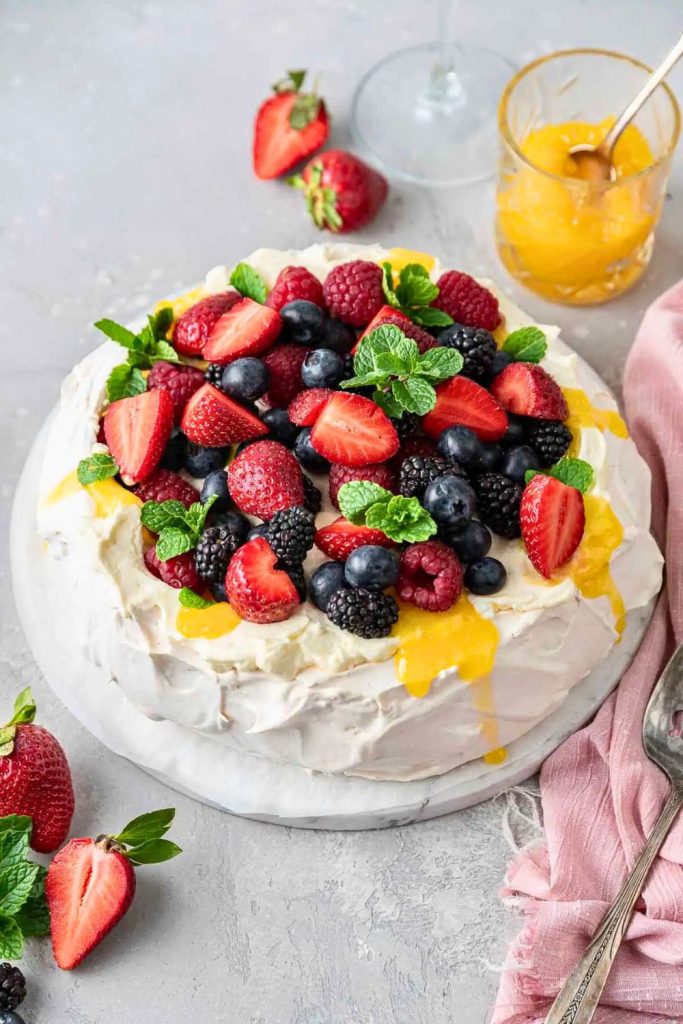
Pavlova suits both formal celebrations and relaxed meals because the topping may be adapted to the occasion.
Stir in the cream and fruit shortly ahead of serving. Moist toppings gradually soften the shell, so last-minute assembly preserves the best contrast.
Use it as a summer-lunch finale or a holiday dessert centerpiece, accompanied by sparkling wine or black coffee.
Cut with a serrated knife using gentle sawing motions. Serve each slice plain or add a small drizzle of fruit coulis, caramel, or melted chocolate.
For a polished presentation, try one or two of these garnishes:
- Add fresh mint for color and a clean herbal note.
- Sprinkle toasted nuts or coconut for extra texture.
- Apply a light dusting of powdered sugar right away ahead of serving.
- Use edible flowers that are specifically sold for culinary use.
For parties, divide the meringue into mini Pavlovas. Individual shells provide the same crisp, creamy, fruity contrast and are simple to portion.
Tips for a Reliable Pavlova
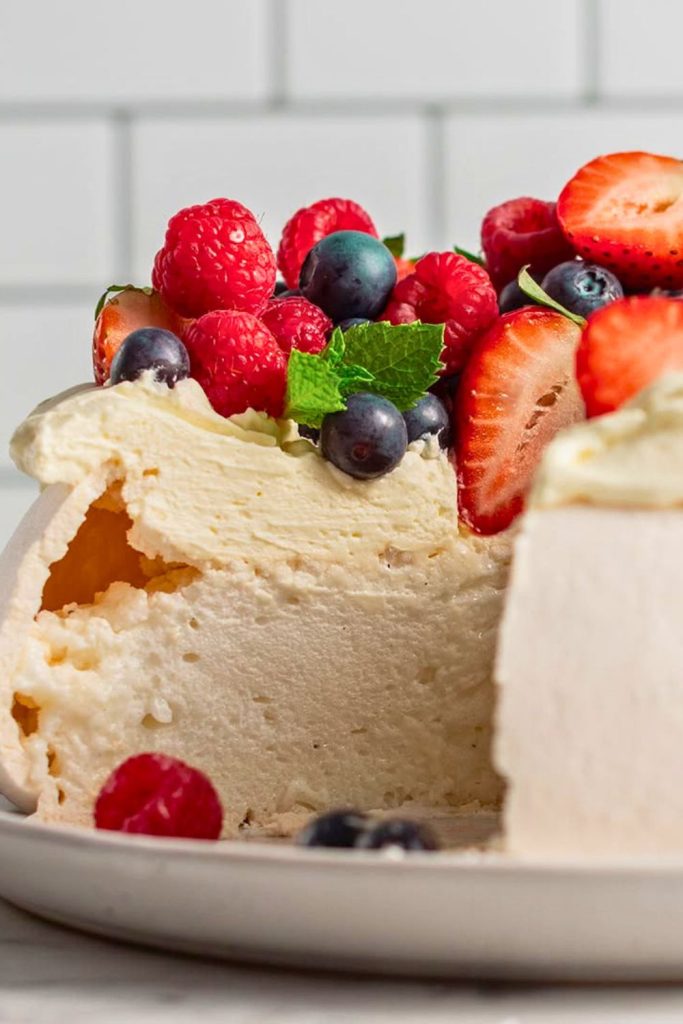
Pavlova depends on technique more than complicated ingredients. These habits help produce a crisp shell and a tender center consistently.
Remember these points in mind:
- Clean every tool: A trace of fat can weaken the foam, so wipe the bowl and beaters with vinegar or lemon juice.
- Use room-temperature whites: They generally whip to greater volume than very cold whites.
- Separate the eggs while cold: Cold yolks are firmer and less likely to break, then the whites can warm before mixing.
- Add the sugar gradually: Slow additions give the crystals time to dissolve and reduce gritty or weeping meringue.
- Whip to glossy stiff peaks: Stop when the foam is thick, shiny, and able to hold a firm point.
- Gently incorporate cornstarch lightly: Use a spatula and broad strokes so the stabilizer blends in without knocking out the air.
- Choose a dry day when possible: High humidity can leave the outer shell sticky.
- Cool it slowly: Leave the baked Pavlova in the switched-off oven to reduce sudden cracking or collapse.
- Top it near serving time: Whipped cream and fruit will soften the crust as they sit.
- Accept small cracks: They are normal, and the cream and fruit will cover many of them.
Following these steps gives you the best chance of a pale, crisp Pavlova with a tender center and stable shape.
Flavor Ideas and Variations
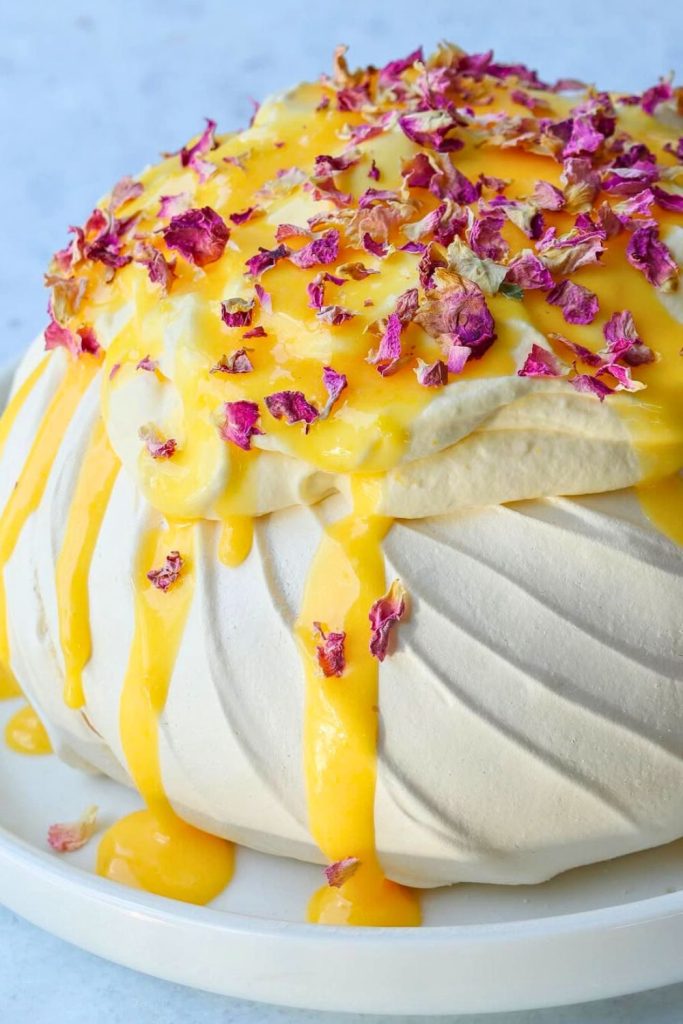
| Variation | Flavor | Topping Ideas |
|---|---|---|
| Classic Pavlova | Vanilla meringue with a tender center | Whipped cream, strawberries, blueberries, and kiwi |
| Chocolate Pavlova | Cocoa folded into the meringue | Raspberries, chocolate shavings, and whipped cream |
| Lemon Pavlova | Bright, tangy lemon curd | Lemon curd, blueberries, and powdered sugar |
| Tropical Pavlova | Fresh tropical fruit | Mango, pineapple, passion fruit, and coconut |
| Berry Pavlova | Sweet-tart summer berries | Mixed berries, mint, and berry coulis |
| Mini Pavlovas | Individual meringue shells | Seasonal fruit with whipped cream or mascarpone |
| Christmas Pavlova | Festive red-and-white presentation | Cranberries, pomegranate, and white chocolate curls |
A Few Final Notes: A Dessert Worth the Effort
Pavlova becomes much easier once you understand how slowly dissolved sugar, stiff peaks, gentle baking, and gradual cooling work together.
The crisp shell, marshmallow center, cool whipped cream, and juicy fruit create a combination that feels both light and celebratory.
The recipe does require patience, but none of the individual steps is complicated. Give the meringue enough time at each stage.
Choose your favorite seasonal fruit, assemble the dessert just ahead of serving, and enjoy the contrast in every slice.
Classic Pavlova with Fresh Fruit
Try These Related Desserts
If you enjoyed this Pavlova, these FeastBears desserts provide more cozy and festive baking ideas:
- 🍰 Classic Tiramisu Recipe for Cozy Nights In: Layer coffee-soaked ladyfingers with creamy mascarpone for a chilled Italian dessert.
- ❤️ Easy Red Velvet Cake Recipe for Home Bakers: Make a moist, cocoa-kissed layer cake finished with smooth frosting.
- 🍪 Best White Chocolate Cranberry Cookies for Christmas: Bake chewy cookies with sweet white chocolate and tart dried cranberries.
Each one adds a different texture and flavor to a Christmas table or a relaxed dessert night.
Dana Brooks is a home-cooking writer at Feastbears, where she shares easy family recipes, cozy dinners, quick desserts, and beginner-friendly kitchen tips. Her goal is to make everyday cooking feel simple, warm, and enjoyable for busy home cooks.